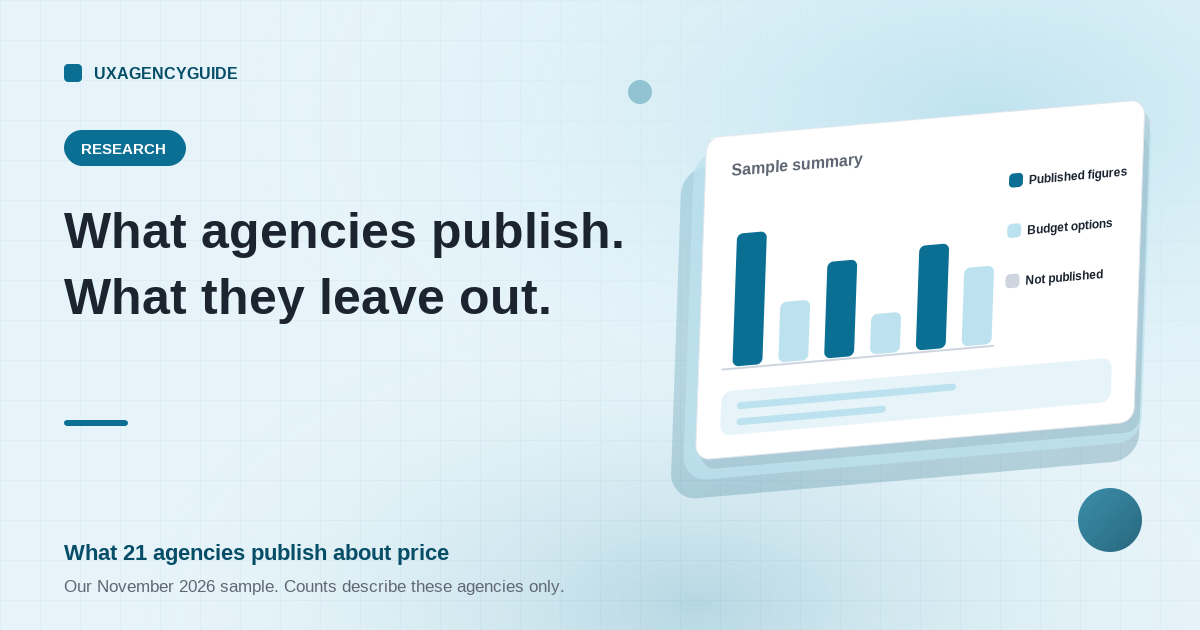
Most UX agencies do not publish their prices. In our November 2026 review of 21 UX and product design agencies, 11 published no pricing on the pages we checked, 3 showed only budget options on their contact forms and 7 published actual figures. Those published figures range from a $2,000 UX audit to strategic engagements shown from €350,000, because they describe very different kinds of work. For buyers, the practical finding is that headline prices are rarely comparable; the scope, duration and team model behind each figure matter more. These counts describe our sample of 21 agencies, not the whole UX agency market.
This benchmark is UXAgencyGuide’s own study. We reviewed each agency’s website, recorded what it publishes about price and engagement terms, and linked every entry to its source. The full dataset is available below and as a CSV download. It is intended for 2027 planning, but it describes what agencies published on 20 November 2026; it is not a record of 2027 prices, availability or project totals.
Key findings at a glance
Each finding below states the sample, the date, the result and its main limitation, so it can be quoted on its own.
- Price visibility. Of 21 UX and product design agencies reviewed on 20 November 2026, 7 (33%) published price figures, 3 (14%) showed budget options only on contact forms and 11 (52%) published no pricing on the pages we checked. “Not published” means we did not find it, not that it does not exist.
- Price spread. Among the 7 agencies that published figures on 20 November 2026, starting points ranged from a $2,000 UX audit (Cieden) to strategic programs shown from €350,000 (UXDA). The figures cover different scopes, so the range is not a price range for the same work.
- Budget bands. The 3 agencies in the sample that showed only contact-form budget options on 20 November 2026 started their lowest band at $8,000 to $15,000 (Agente), under $25,000 (Neuron) and under $50,000 (HTEC Momentum). Budget bands show the projects an agency expects, not what it charges.
- Team models. 12 of the 21 agencies (57%) described a dedicated, embedded or team-based model on 20 November 2026; where a minimum was stated, it was six months (CorLab Tech, Cieden). Agencies that did not describe a team model may still offer one.
- Free trials. 2 of the 21 agencies (10%) stated a free trial on 20 November 2026: Arounda (three days) and UX Studio (five days). One more, CorLab Tech, describes a trial month on real work without saying it is free, and Think Company offers a free half-day workshop, which is not a trial.
Research question and collection date
We set out to answer a practical question for people hiring a UX agency: what do agencies publish about price and engagement terms before you contact them?
That question breaks into five parts:
- Does the agency publish any price figures, rates or minimums?
- If not, does it show budget ranges, for example on a contact form?
- What scope does the agency describe: design-led work, design and build, or engineering-led delivery?
- What engagement models, durations and minimums does it state?
- Does it offer a trial, and does it say the trial is free?
All data was collected on 20 November 2026. Prices and terms change, so each entry should be read as what the agency published on that date. We did not contact agencies, request quotes or use third-party directories; every entry comes from the agency’s own website.
Sample and inclusion method
The sample is the 21 agencies that UXAgencyGuide covers across its agency guides: Agente, Arounda, Aufait UX, Cieden, CorLab Tech, Fantasy, Fuselab Creative, Fuzzy Math, GoInvo, Guidea, HTEC Momentum, Lazarev.agency, Metalab, Netguru, Neuron, Qubstudio, Think Company, ustwo, UXDA, UX Studio and Work & Co.
This is a defined editorial sample, not a representative survey of the UX agency market. It includes design studios, domain specialists, enterprise UX teams and engineering-led firms, in several countries and at very different sizes. That variety is useful for showing how differently agencies present their terms, but the shares reported below describe these 21 agencies only.
For each agency, we reviewed the homepage and the pages reachable from its navigation that were most likely to contain pricing or engagement terms: pricing, services, process, engagement models and contact pages. Where a page published figures, we recorded them exactly as shown, including currency. Where a contact form listed budget options in its page text, we recorded those separately, because a budget range on a form is not a published price. Where we found nothing, we recorded “not published” and listed the pages we checked in the source column.
Published price and engagement fields
Each row in the dataset records the following fields.
| Field | What it records |
|---|---|
| Scope type | Design-led (design and research, perhaps with front-end support), design and build (design plus in-house engineering), or engineering-led (software delivery with design as part of the team) |
| Pricing visibility | Published figures, contact-form budget options only, or not published |
| Published figures or budget options | The figures exactly as shown, with currency |
| Pricing model | Hourly, fixed price, monthly team capacity, time and materials or not stated |
| Engagement models | Project types and team arrangements described |
| Stated durations | Timelines, minimums and engagement lengths |
| Trial type | Free trial (the page says it is free), trial period with cost not stated, free introductory session, or none stated |
| Trial details | What the page says about the trial or free start, in our words |
| Team model stated | Whether a dedicated, embedded or team-based model is described |
| Sources | The pages reviewed, with the collection date |
Definitions
Published figures means a price, rate, range or minimum stated on the agency’s own page, such as “projects start at $10,000” or “$100 to $150 per hour”. Contact-form budget options are ranges offered in an enquiry form; they show the budgets an agency expects to discuss, not what it charges. Not published means we found neither on the pages we reviewed; it does not mean the agency has no standard pricing.
We did not convert currencies. One agency in the sample shows figures in euros; all other figures are in US dollars as shown. We did not calculate averages, because the figures describe different scopes, and an average of an audit, an hourly rate and a strategic engagement would be meaningless.
Results that the actual sample supports
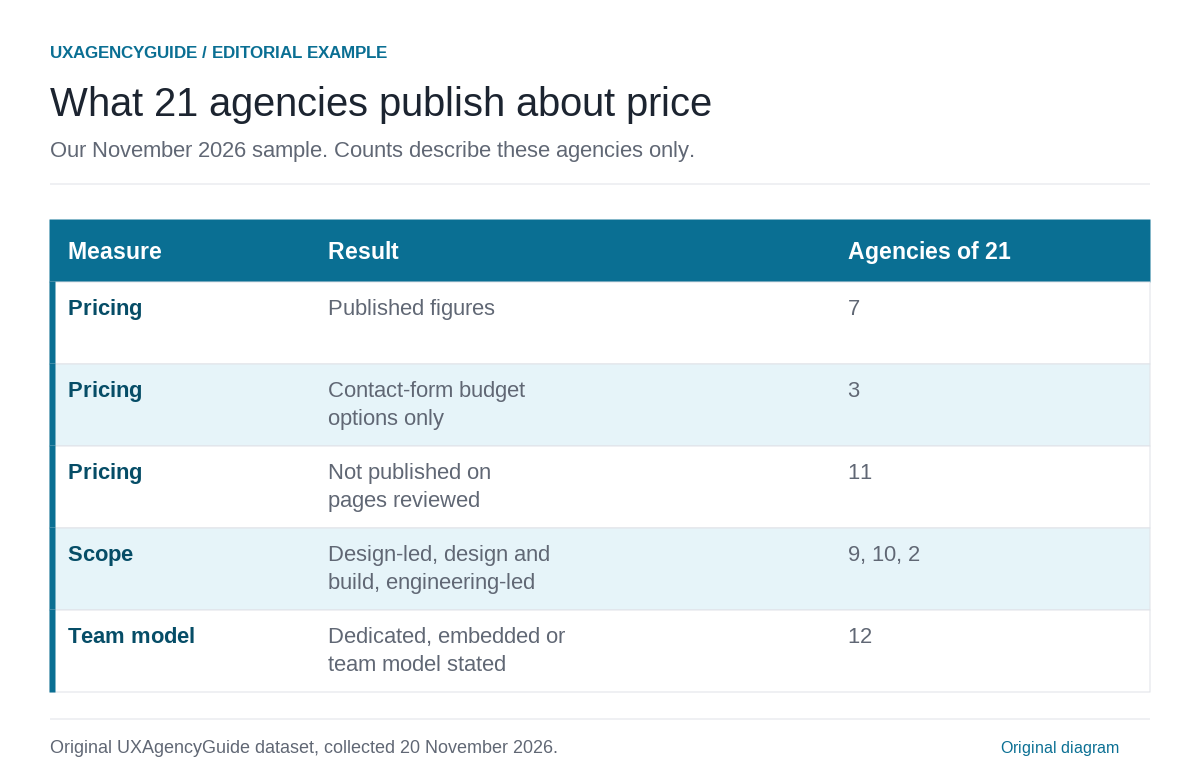
Sample of 21 agencies; pages checked 2026-11-20. Shares are of this sample only.
| Field | Result | Agencies (of 21) | Share |
|---|---|---|---|
| Pricing visibility | Published figures | 7 | 33% |
| Pricing visibility | Contact-form budget bands only | 3 | 14% |
| Pricing visibility | Not published | 11 | 52% |
| Scope type | Design-led | 9 | 43% |
| Scope type | Design and build | 10 | 48% |
| Scope type | Engineering-led | 2 | 10% |
| Engagement model | Dedicated, embedded or team model stated | 12 | 57% |
| Trial or free start | Free trial | 2 | 10% |
| Trial or free start | Trial period, cost not stated | 1 | 5% |
| Trial or free start | Free introductory session | 1 | 5% |
Finding 1: most agencies in the sample do not publish prices
In short: on 20 November 2026, 11 of the 21 agencies in our sample (52%) published no pricing on the pages we reviewed, 3 (14%) showed budget options only on contact forms and 7 (33%) published figures of any kind.
For a buyer, that means a first conversation is usually needed before cost becomes clear. The limitation is that we only read public pages; agencies may share standard rates in proposals.
Finding 2: published figures describe different scopes
In short: the 7 agencies in our sample that published figures on 20 November 2026 ranged from a $2,000 UX audit to strategic programs from €350,000, but the figures describe different scopes and should not be read as a price range for the same work.
The seven agencies that publish figures are not publishing comparable things:
- Fixed-scope audits and starter offers. Cieden publishes UX audit tiers of $2,000, $2,800 and from $3,800. Think Company lists a Product UX Audit at about $50K and a four-week Vision Sprint at about $50K, alongside a free half-day workshop. GoInvo lists a Design Diagnostic of four to eight weeks with a typical investment of $50K to $90K.
- Prototypes and builds. Cieden lists AI prototyping from $8,000 for a sprint, $16,000 for a proof-of-concept app and $32,000 for an MVP app. CorLab Tech states that MVP and dashboard projects start at $10,000. GoInvo lists a Product Launch of two to four months at $75K to $250K.
- Website redesigns. Arounda publishes redesign ranges of $5,000 to $10,000 for a basic redesign of up to five to seven pages, $10,000 to $20,000 for a standard redesign and $20,000 or more for complex work, and says typical projects start from $6,000.
- Rates. Fuselab Creative publishes $100 to $150 per hour, with engagements from $25,000.
- Strategic programs. UXDA’s homepage case-study tiles show strategic UX engagements from €350,000 to from €500,000 for large financial institutions.
The spread from $2,000 to €350,000 reflects the difference between a five-day audit and a multi-year banking program, not a difference in price for the same work.
Finding 3: budget options signal the expected starting range
In short: on 20 November 2026, the lowest contact-form budget option was $8,000 to $15,000 at Agente, under $25,000 at Neuron and under $50,000 at HTEC Momentum; these are the budgets each agency expects to discuss, not its prices.
The three agencies that show only contact-form budget options offer different starting bands. Agente’s lowest option is $8,000 to $15,000. Neuron’s lowest is less than $25,000. HTEC Momentum’s lowest is under $50,000. These bands are a useful signal of the projects each agency expects, but they are not prices.
Finding 4: team-based engagement is common
In short: 12 of the 21 agencies (57%) described a dedicated, embedded or team-based model on 20 November 2026, and the two that stated a minimum for it set it at six months.
Twelve of the 21 agencies describe a dedicated, embedded or team-based model, from Cieden’s and CorLab Tech’s dedicated teams to UX Studio’s embedded designers and Work & Co’s fully dedicated teams. Where minimums are stated, they tend to be long: CorLab Tech describes six months as a practical minimum for its dedicated teams, and Cieden offers fixed monthly pricing only for partnerships of six months or more.
Finding 5: durations are stated more often than prices
In short: several agencies in our sample that published no prices on 20 November 2026 did publish durations, such as Netguru’s two-to-six-week discovery and ustwo’s six-week to multi-year services. Durations show scale, not cost.
Agencies that do not publish prices often publish durations. Netguru describes discovery engagements of two to six weeks and product design projects of two to six months. ustwo lists engagement lengths from six weeks to more than a year depending on the service. Qubstudio describes audits of up to two or four weeks. Durations give buyers a useful sense of scale even without figures.
Finding 6: free trials are uncommon
In short: 2 of the 21 agencies in our sample (10%) stated a free trial on 20 November 2026: Arounda and UX Studio. The sample is editorial, so this share describes these agencies only.
We separate three kinds of low-commitment start, because they are easy to confuse:
| Trial type | Agency | What the page says |
|---|---|---|
| Free trial | Arounda | A three-day trial on its three design tiers, which the pricing page says is free. The developer tiers do not list a trial. |
| Free trial | UX Studio | A five-day trial described as no cost and no commitment, leaving two to three designed screens. |
| Trial period, cost not stated | CorLab Tech | The first month of a dedicated team is a trial month on the client’s real backlog, with fit reviewed together at the end. The page does not say the month is free, and the same page describes six months as the practical minimum. |
| Free introductory session | Think Company | A half-day Think Session workshop at no charge. It is an introduction, not a trial of the delivery team. |
Other agencies offer short paid or unpriced starting points rather than trials, such as Fuzzy Math’s one-week engagements and Cieden’s fixed-price audits. If a trial matters to you, ask whether it is paid, what you keep at the end and what commitment follows it.
Missing data and scope differences
The largest limitation of the dataset is missing data. For 11 agencies we found no pricing, and for several we found few stated terms. Missing data in this study means “not published on the pages we reviewed”, not “unavailable”. Agencies may share standard rates in proposals, sales conversations or documents we did not see.
Several specific gaps are worth stating:
- Metalab. The homepage returned very little text when we reviewed it, which suggests content that loads with JavaScript. We recorded what its work page shows, but pricing and engagement terms may exist that we could not read.
- Fantasy. The contact form asks for an estimated budget, but its options did not appear in the page text we reviewed, so we could not record them.
- Guidea. The site states that Guidea has joined Invene. We recorded Guidea’s own pages as published; terms may change following that combination.
- Scope classification. Our three scope types simplify a continuum. Several design-led agencies offer front-end support, and several design and build studios also take design-only work. The classification reflects what each agency’s pages emphasize.
Scope differences also limit comparison. An agency that publishes an audit price and one that publishes a build minimum cannot be compared on price; the comparison only works for similar scopes. We recommend comparing proposals for your own defined scope, using the published figures only as a starting reference.
Downloadable data and limitations
The full dataset is below and available as a CSV file containing every field, all source URLs and the collection date. You are welcome to use it; please cite UXAgencyGuide and the collection date of 20 November 2026.
| Agency | Scope | Pricing visibility | Published figures or budget options | Engagement and duration | Trial type | Trial details | Main source |
|---|---|---|---|---|---|---|---|
| Agente | Design and build | Contact-form budget bands only | Contact-form budget options start at $8,000 to $15,000 and run to more than $50,000 | Dedicated team listed as a service; five-day design sprint described. Not stated. | None stated | None stated | agentestudio.com |
| Arounda | Design and build | Published figures | Website redesign: basic $5,000 to $10,000 (up to 5 to 7 pages), standard $10,000 to $20,000, complex $20,000+; typical projects from $6,000 | Part-time designer, full-time designer, design team, developer tiers. Redesign 3+ weeks (simple) to 7+ weeks (complex); start within 3 to 5 business days. | Free trial | 3-day free trial on the three design tiers; the pricing page says the trial is free | arounda.agency |
| Aufait UX | Design-led | Not published | None found on pages reviewed | Subscription model mentioned; UI and front-end development listed. UX audit typically 3 to 4 weeks. | None stated | None stated | aufaitux.com |
| Cieden | Design-led | Published figures | UX audit $2,000, $2,800, from $3,800; AI prototyping from $8,000 (sprint), $16,000 (PoC app), $32,000 (MVP app) | Fixed-price audits and prototypes; dedicated design team. Dedicated team best for 6+ months; audits delivered in 5 to 8 days. | None stated | None stated | cieden.com |
| CorLab Tech | Engineering-led | Published figures | MVP projects start at $10,000; dashboard projects start at $10,000 | Dedicated teams of typically 3 to 8 people including design. MVP 6 to 8 weeks for most first versions; dedicated team practical minimum 6 months. | Trial period, cost not stated | First month of a dedicated team runs as a trial month on the client’s real backlog, with fit reviewed at the end; the page does not say this month is free | corlab.tech |
| Fantasy | Design and build | Not published | None found on pages reviewed | Embedded acceleration teams, or Fantasy leads the build. Depends on scope. | None stated | None stated | fantasy.co |
| Fuselab Creative | Design-led | Published figures | $100 to $150 per hour; engagements from $25,000 | Not stated on page reviewed. Not stated. | None stated | None stated | fuselabcreative.com |
| Fuzzy Math | Design-led | Not published | None found on pages reviewed | Three one-week engagements offered: AI in Design Training, Strategy Workshop, UX and Competitive Evaluation. One-week starter engagements. | None stated | None stated | fuzzymath.com |
| GoInvo | Design and build | Published figures | Design Diagnostic typical investment $50K to $90K; Product Launch $75K to $250K; Embedded Partnership custom | Design Diagnostic, Product Launch, Embedded Partnership. 4 to 8 weeks; 2 to 4 months; 6 to 24 months. | None stated | None stated | goinvo.com |
| Guidea | Design-led | Not published | None found on pages reviewed | Four-phase process (Innovate, Launch, Sprint, Scale); site banner states Guidea has joined Invene. Not stated. | None stated | None stated | guidea.com |
| HTEC Momentum | Design and build | Contact-form budget bands only | Contact-form budget options: under $50,000; $50,000 to $100,000; $100,000 to $250,000; over $250,000 | Strategy, design, technology and data capabilities listed. Not stated. | None stated | None stated | momentumdesignlab.com |
| Lazarev.agency | Design-led | Not published | None found on pages reviewed | Multi-month engagements with milestone reviews and a single accountable lead. Multi-month. | None stated | None stated | lazarev.agency |
| Metalab | Design and build | Not published | None found on pages reviewed | Portfolio lists projects as full builds including engineering; homepage text was limited when reviewed. Not stated. | None stated | None stated | metalab.com |
| Netguru | Engineering-led | Not published | None found on pages reviewed | Fixed-scope project, dedicated team, staff augmentation, delivery center. Discovery 2 to 6 weeks; product design projects 2 to 6 months; dedicated team operational in 4 to 6 weeks. | None stated | None stated | netguru.com |
| Neuron | Design-led | Contact-form budget bands only | Contact-form budget options: less than $25,000; $25,000 to $50,000; $50,000 to $100,000; $100,000 or more | Project-based to full-scale team augmentation; two-week sprints. Not stated. | None stated | None stated | neuronux.com |
| Qubstudio | Design and build | Not published | None found on pages reviewed | Design and development services; startup offerings such as audits and concept sprints. UX health check up to 2 weeks; strategic audit up to 4 weeks. | None stated | None stated | qubstudio.com |
| Think Company | Design and build | Published figures | Think Session (half-day workshop) no charge; Think Vision Sprint about $50K; Product UX Audit about $50K | Embedded teams and staffing; product design and build. Vision Sprint four weeks. | Free introductory session | No trial stated; a half-day Think Session workshop is offered at no charge | thinkcompany.com |
| ustwo | Design and build | Not published | None found on pages reviewed | Discover, Shape, 0-1 and Boost services; Boost integrates scalable teams. Discover from 8 weeks; Shape from 3 months; 0-1 from 6 weeks to over a year; Boost from 6 weeks. | None stated | None stated | ustwo.com |
| UXDA | Design-led | Published figures | Case-study tiles show strategic UX engagements from €350,000 to from €500,000 | Strategy to UI design with implementation support. Not stated. | None stated | None stated | theuxda.com |
| UX Studio | Design-led | Not published | None found on pages reviewed | Dedicated, embedded UX teams in the client’s tools; weekly ship cadence. Not stated. | Free trial | Free 5-day trial; the homepage says no cost and no commitment, and the trial leaves 2 to 3 designed screens | uxstudioteam.com |
| Work & Co | Design and build | Not published | None found on pages reviewed | Same core team throughout; development starts at kickoff. Process target of 20 days to market feedback. | None stated | None stated | work.co |
Limitations
- Sample. Twenty-one agencies chosen for editorial coverage, not a random or representative sample. Shares describe this sample only.
- Date. Collected on 20 November 2026. Prices and terms change; confirm them with each agency.
- Published only. We recorded public website information. We did not request quotes, contact agencies or verify that published figures are honored in practice.
- No quality judgment. The benchmark says nothing about the quality, results or fit of any agency. Publishing prices is a commercial choice, not a measure of capability.
- Currency. Figures are shown as published; we did not convert currencies.
- Interpretation. Scope types and pricing categories are our classifications, defined above.
How to use the benchmark
Use the published figures to set a rough expectation for different kinds of work, then define your own scope and ask several agencies to respond to it. Our UX design brief template helps you write that scope, and our agency evaluation scorecard helps compare the responses. For choosing between an agency, a freelancer and an in-house team, see our comparison of delivery models, and for agencies by buying situation, our guide to the best UX design agencies.
Because every entry records its source and date, the review can be repeated with the same method to show how published terms change over time.
Frequently asked questions
Do UX agencies offer free trials?
Rarely. In our review of 21 UX and product design agencies on 20 November 2026, two stated a free trial: Arounda (three days on its design tiers) and UX Studio (five days). CorLab Tech describes a first trial month on real work but does not say it is free, and Think Company offers a free half-day workshop rather than a trial. The sample is editorial, not representative of the whole market.
How much do UX agencies charge?
Most of the agencies in our sample do not publish prices. Among the seven that do, published starting points range from a $2,000 UX audit to strategic engagements shown from €350,000, because they describe very different scopes. Compare prices for the same scope, not headline figures.
Why don’t more agencies publish their prices?
Design work varies widely in scope, research needs, team size and engineering responsibility, so many agencies quote per project. Several in our sample instead publish fixed-scope starter offers, hourly rates or budget ranges on their contact forms.
Are these 2027 prices?
No. The data was collected on 20 November 2026 from agencies’ public websites. It is intended to help with 2027 planning, but prices and terms change and should be confirmed directly with each agency.
Can I use the data?
Yes. The full dataset is available as a CSV download with source links and the collection date. Please cite UXAgencyGuide and the collection date when you reference it.
Is this a ranking of agencies?
No. The benchmark records what each agency publishes about price and engagement terms. It does not evaluate quality, results or fit. Publishing prices, or not publishing them, says nothing about an agency’s capability.
Sources & evidence
- Agente UX/UI design servicesChecked 2026-11-20
- Arounda pricingChecked 2026-11-20
- Arounda website redesignChecked 2026-11-20
- Aufait UX UX auditChecked 2026-11-20
- Cieden UX audit servicesChecked 2026-11-20
- Cieden AI prototyping servicesChecked 2026-11-20
- Cieden dedicated design teamChecked 2026-11-20
- CorLab Tech MVP developmentChecked 2026-11-20
- CorLab Tech dedicated teamsChecked 2026-11-20
- Fantasy product innovationChecked 2026-11-20
- Fuselab Creative AI product designChecked 2026-11-20
- Fuzzy MathChecked 2026-11-20
- GoInvo servicesChecked 2026-11-20
- Guidea processChecked 2026-11-20
- HTEC Momentum capabilitiesChecked 2026-11-20
- Lazarev.agencyChecked 2026-11-20
- Metalab workChecked 2026-11-20
- Netguru dedicated teamsChecked 2026-11-20
- Neuron servicesChecked 2026-11-20
- Neuron contactChecked 2026-11-20
- QubstudioChecked 2026-11-20
- Think Company how we helpChecked 2026-11-20
- ustwo servicesChecked 2026-11-20
- UXDAChecked 2026-11-20
- UX StudioChecked 2026-11-20
- Work & Co processChecked 2026-11-20
Specific sources, useful examples and clear limitations make advice easier to assess.
Read the editorial policy