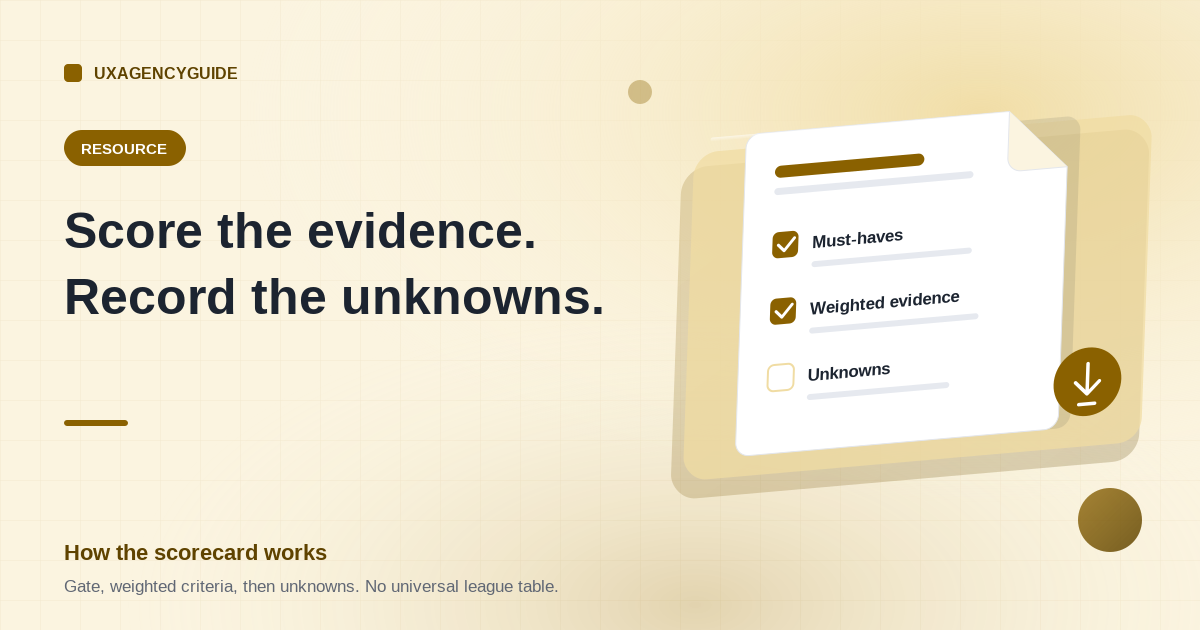
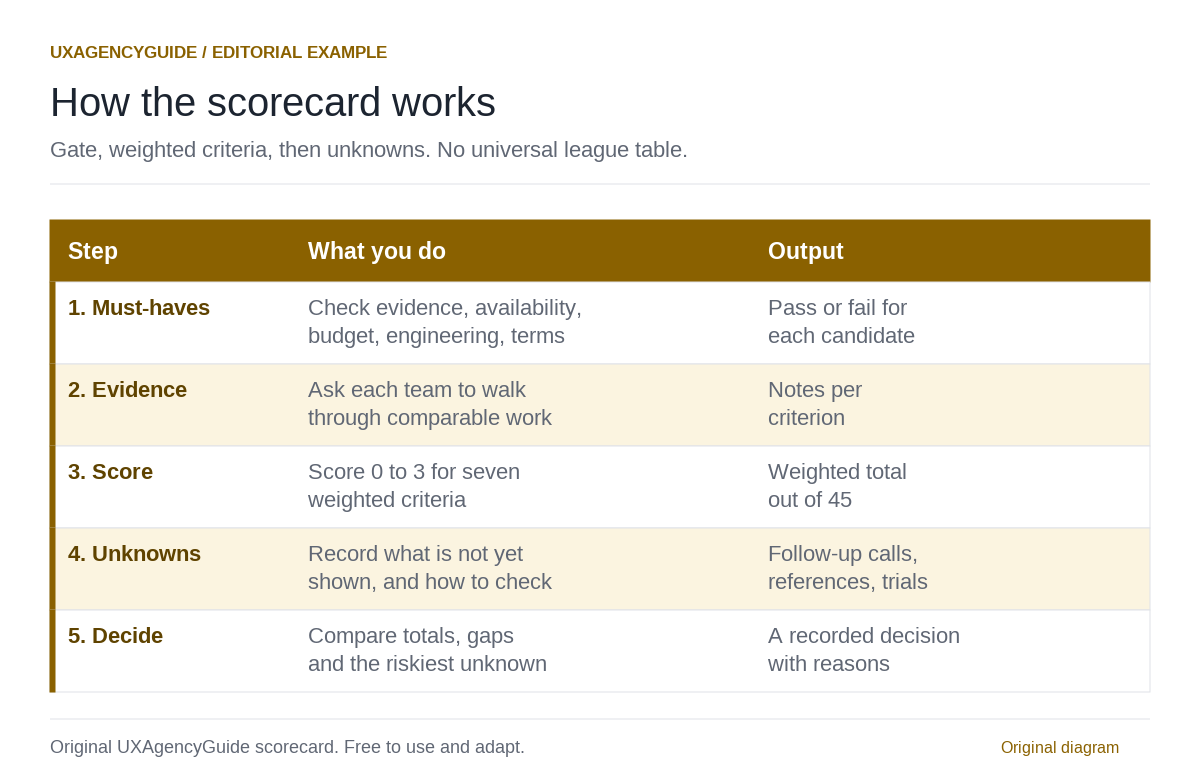
A UX agency evaluation scorecard helps a hiring team compare agencies on the evidence they actually show, rather than on reputation or presentation. This page gives you an editable scorecard with a pass-or-fail gate for must-haves, seven weighted criteria scored from 0 to 3, a record for unknowns and a worked scenario. It is designed to collect evidence and make trade-offs visible, not to produce a universal league table of agencies.
Download the UX agency evaluation scorecard (.docx). The Word file includes the must-haves gate, the criteria and scale, a blank scoring sheet for three candidates, an unknowns record and the worked scenario. It is an original UXAgencyGuide resource, free to use and adapt.
Define the project and must-haves
A scorecard only works if everyone scoring knows what the project is. Write a short brief first; our UX design brief template covers the essentials. Then agree the must-haves: conditions any candidate has to meet before scoring is worth the effort.
The template suggests five must-haves:
- Relevant product or domain evidence: at least one comparable project the proposed team can walk through.
- Availability: can start and staff the work within your timeline.
- Budget fit: the proposal falls within your range for the agreed scope.
- Engineering fit: can work with your stack, component library or build partner.
- Terms: acceptable ownership of files and research, confidentiality and notice periods.
Treat these as a gate. A candidate who fails a must-have is out, however strong the portfolio. That prevents a polished presentation from outweighing a basic mismatch, such as an agency that cannot start for four months when you need to launch in three.
Collect project evidence
The most important criterion is relevant project evidence, weighted highest in the template. Good evidence is a comparable project with named users, decisions and the agency’s documented role.
Different kinds of provider produce different kinds of evidence. Four common types illustrate the range:
- Product studios often show early-stage products taken from concept to brand and interface. Metalab’s archived Slack case describes a historical engagement covering product, brand, mobile app and marketing site, and its current portfolio presents work from startups to Fortune 500 companies, with some projects listed as full builds.
- Domain specialists show depth in one sector. GoInvo’s CodeRyte case describes a staged healthcare engagement through a proof of concept, a working prototype and more than 15 prototypes, under HIPAA and patient-data constraints.
- Enterprise UX teams show complex workflow products and embedded partnerships. Neuron’s Vendr case describes an embedded design partnership on a procurement workflow product, handed off to the client’s developers after a four-month first engagement.
- Engineering-led providers show built products and delivery capacity, with design as part of a team. CorLab Tech’s dedicated teams are typically three to eight people across engineering, QA and design, with a six-month practical minimum.
We cite these as examples of provider types and the evidence each tends to show. We do not score them, and the worked scenario below uses fictional candidates.
What makes evidence strong
Ask each candidate to walk through the project closest to yours. Strong evidence names the users and their tasks, explains a hard decision and what was rejected, separates the agency’s contribution from the client’s and other suppliers’, and attributes any results to their source. A case study is the agency’s account of its own work; treat reported outcomes as claims to discuss, not as independent proof.
Use the scale consistently
The scoring scale is designed to reward shown evidence over claims:
- 0: no evidence offered.
- 1: claimed, but not shown.
- 2: shown in comparable work.
- 3: shown in comparable work and explained by the proposed team.
The step from 2 to 3 matters. An agency’s portfolio may include excellent work by people who will not be on your project. A score of 3 requires the proposed team to explain the work themselves.
Evaluate scope and team
The second-highest weight goes to the proposed team and continuity. Ask who exactly will work on the project, what comparable work they did and what happens if someone leaves. Small teams can be very effective, but carry more risk if one person is unavailable.
The remaining criteria cover:
- Research approach: a plan that matches your question, participants and access. GOV.UK’s guidance on what each role does in a service team is a useful reminder that research is a distinct role; check whether the proposal includes it.
- Interaction and interface quality: work that covers states, errors and accessibility, not only ideal screens. Ask to see an error or empty state the team designed.
- Delivery and handoff: clear deliverables, specifications and support during the build.
- Collaboration fit: a working rhythm, tools and decision process that fit yours.
- Commercial clarity: an itemized scope with assumptions, exclusions and a change process. Published prices are rare; where they exist, such as Fuselab Creative’s published rates of $100 to $150 per hour with engagements from $25,000, they are starting points rather than quotes.
Score independently, then compare
Ask each person on the hiring team to score independently before discussing. Large differences between scorers usually mean the evidence was unclear or the criterion was interpreted differently; discuss those first.
Record limitations and unknowns
An unknown is not the same as a low score. If an agency has not yet shown its research approach, scoring it 0 penalizes it for a question you have not asked. Instead, record it as an unknown and decide how to find out: a follow-up call, a reference or a short paid trial.
Several providers offer trials that can resolve unknowns. CorLab Tech describes a trial month on real tasks, for example. Agree in advance what the trial should show.
Record limitations too. A comparable project that was much larger than yours, a team member new to the agency or a portfolio from a different sector are all relevant, even when the score is high.
Worked decision scenario
The scenario below shows the scorecard in use. A company is choosing a design partner for a clinical scheduling tool used by hospital teams. Four fictional candidates represent the provider types above. All four passed the must-haves. The scores are illustrative, showing how to use the scorecard, and are not ratings of any real agency.
Illustrative scenario. Candidates A to D are fictional and represent four common provider types. Scores are examples of how to use the scorecard, not ratings of any real agency.
| Criterion | Weight | A: product studio | B: health specialist | C: enterprise UX team | D: engineering-led |
|---|---|---|---|---|---|
| Relevant project evidence | 3 | 2 | 3 | 2 | 1 |
| Proposed team and continuity | 3 | 2 | 2 | 3 | 3 |
| Research approach | 2 | 2 | 3 | 2 | 1 |
| Interaction and interface quality | 2 | 3 | 2 | 2 | 2 |
| Delivery and handoff | 2 | 2 | 2 | 3 | 3 |
| Collaboration fit | 2 | 3 | 2 | 2 | 2 |
| Commercial clarity | 1 | 2 | 2 | 2 | 3 |
| Weighted total | 34 | 35 | 35 | 31 |
| Candidate | Main unknown to resolve |
|---|---|
| A: product studio | Has not shown clinical research experience; may need a clinical adviser. |
| B: health specialist | Proposed team includes one designer new to the agency; ask for a reference. |
| C: enterprise UX team | Comparable project was much larger; check fit for a small product team. |
| D: engineering-led | Design capacity is one designer inside a build team; research plan is thin. |
Reading the scenario
Two candidates share the highest weighted total of 35, the product studio is one point behind and the engineering-led candidate trails at 31. The score narrows the choice but does not make it. The health specialist has the strongest research approach and domain evidence, which matter for a clinical product; its unknown is a single reference check. The enterprise UX team has the strongest team continuity and delivery, but its comparable project was much larger. In this scenario, the hiring team calls a reference for the health specialist and asks the enterprise team how it would staff a smaller product, then decides. The engineering-led candidate scores well on delivery and commercial clarity, but its thin research plan is a serious gap for a clinical tool, which the unknowns record makes explicit.
The lesson is that the scorecard’s value lies in the evidence and unknowns it collects, not in the total alone.
Download and adapt the scorecard
The full scorecard is below. The Word file adds a must-haves table with columns for three candidates, a blank scoring sheet with an evidence notes column and an unknowns record.
First check each candidate against your must-haves. Then score the candidates that pass, using the evidence they actually showed you. Record what you saw and what is still unknown; an unknown is not the same as a low score.
Step 1: must-haves (pass or fail)
| Must-have | What passing looks like |
|---|---|
| Relevant product or domain evidence | At least one comparable project the proposed team can walk through. |
| Availability | Can start and staff the work within your timeline. |
| Budget fit | Proposal falls within your range for the agreed scope. |
| Engineering fit | Can work with your stack, component library or build partner. |
| Terms | Acceptable ownership of files and research, confidentiality and notice periods. |
Step 2: weighted criteria
| Criterion | Weight | Strong evidence looks like | Question to ask |
|---|---|---|---|
| Relevant project evidence | 3 | A comparable project with named users, decisions and the agency’s documented role. | Which project is closest to ours, and what did your team decide? |
| Proposed team and continuity | 3 | Named people who did comparable work, with a plan for absences. | Who will work on this, and what happens if someone leaves? |
| Research approach | 2 | A plan that matches our question, participants and access. | How would you learn what you need, and with whom? |
| Interaction and interface quality | 2 | Work that covers states, errors and accessibility, not only ideal screens. | Show us an error or empty state you designed. |
| Delivery and handoff | 2 | Clear deliverables, specifications and support during the build. | What will our engineers receive, and what happens after? |
| Collaboration fit | 2 | A working rhythm, tools and decision process that fit ours. | How do you run reviews and record decisions? |
| Commercial clarity | 1 | Itemized scope, assumptions, exclusions and change process. | What is excluded, and how are changes priced? |
Scoring scale
| Score | Meaning |
|---|---|
| 0 | No evidence offered. |
| 1 | Claimed, but not shown. |
| 2 | Shown in comparable work. |
| 3 | Shown in comparable work and explained by the proposed team. |
Multiply each score by the criterion’s weight and add them up. The maximum is 45. Record evidence notes and unknowns for every candidate.
How to adapt it
- Change the weights to match your project. For a research-heavy project, raise research approach to 3. For a short, well-defined build, raise delivery and handoff.
- Add domain criteria for regulated products, such as experience with clinical review or financial compliance.
- For freelancers, combine the team criteria into one and drop continuity planning to a must-have.
- For in-house hiring, replace commercial clarity with role fit and growth potential.
Keep the completed scorecards with the decision record. They explain why you chose a partner, which is useful when the project is reviewed and when the next hiring decision comes around. For a wider view of agencies by buying situation, see our guide to the best UX design agencies, and for the choice between agency, freelancer and in-house options, our comparison of delivery models.
Frequently asked questions
How do I evaluate a UX agency?
Start with must-haves such as relevant evidence, availability, budget fit and acceptable terms. For agencies that pass, score comparable project evidence, the proposed team, research approach, interface quality, delivery, collaboration fit and commercial clarity, using what each agency actually showed you. Record unknowns separately.
What criteria matter most when choosing a UX agency?
Relevant project evidence and the team that will actually do the work usually matter most, which is why the scorecard weights them highest. A strong portfolio from people who will not work on your project is weaker evidence than a smaller body of comparable work from the proposed team.
Should the highest score always win?
No. The score organizes evidence; it does not make the decision. Look at the unknowns, the size of the differences and how each candidate would handle your riskiest problem. A close score with a serious unknown may favor the lower-scoring candidate.
Can I use the scorecard for freelancers and in-house candidates?
Yes, with small changes. For freelancers, combine the team criteria into one. For in-house hiring, replace commercial clarity with fit for the role and growth potential. The evidence-first approach works for any design hire.
Sources & evidence
- Slack product design case studyChecked 2026-11-20
- Our workChecked 2026-11-20
- Natural language processing software for hospital codingChecked 2026-11-20
- Vendr case studyChecked 2026-11-20
- Dedicated development teamsChecked 2026-11-20
- AI product design agency for regulated and enterprise AIChecked 2026-11-20
- What each role does in a service teamChecked 2026-11-20
Specific sources, useful examples and clear limitations make advice easier to assess.
Read the editorial policy