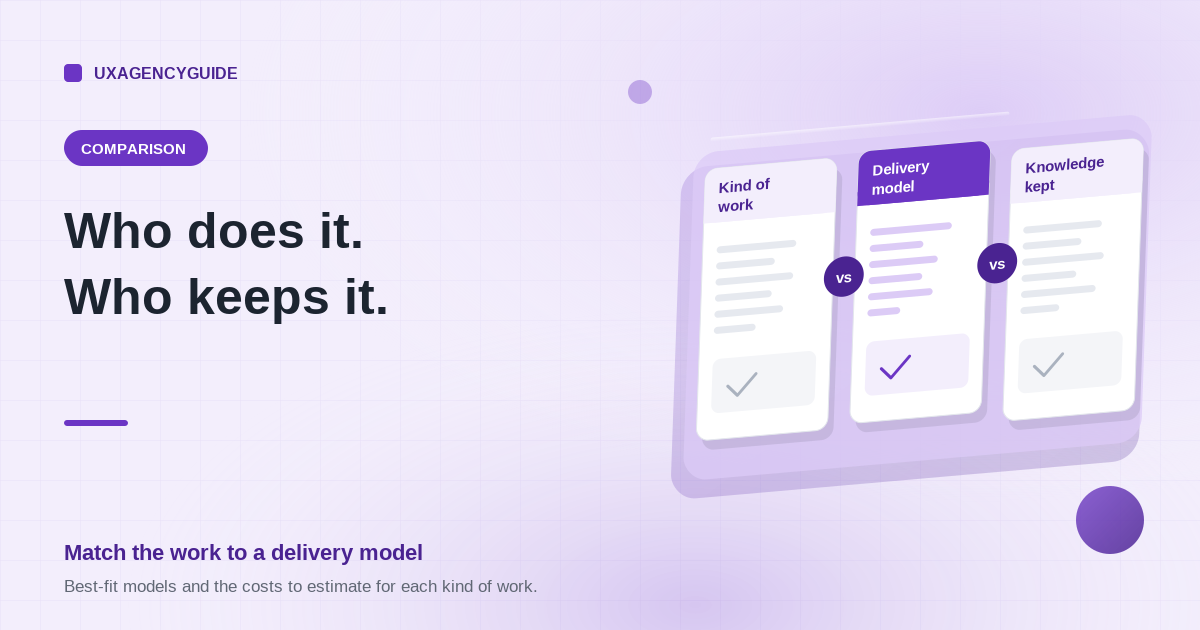
Choose a freelancer for a well-defined task one skilled person can complete, an agency for work that needs several skills or a team that can scale, and an in-house team for continuous product work where knowledge and relationships compound over time. The right model depends less on price than on how long the work lasts, how many skills it needs and who will own design decisions after the work is done. Many teams end up with a combination.
This comparison helps founders and product leaders choose. It compares the three models, explains the trade-offs in scope and continuity, works through cost assumptions without inventing market rates and shows when a hybrid makes sense. It uses engagement models that agencies publish on their own websites, checked in November 2026.
Define the work and ownership need
Before comparing models, describe the work in four ways.
Duration. Is this a project with an end, such as an audit, a redesign or an MVP, or ongoing work on a product that will keep changing?
Breadth of skills. Does it need one discipline, such as interface design, or several, such as research, interaction design, visual design, content and front-end development?
Domain depth. Does the work need specialist knowledge, such as healthcare, finance or AI behavior?
Ownership. Who will make design decisions after the work is done, and where will the knowledge live?
GOV.UK’s guidance on what each role does in a service team is a useful reminder of breadth. It lists roles a service team must have, including a product manager, user researcher, content designer, designer and developer, and suggests that in discovery, an interaction designer is often the best first design hire. One person rarely covers all of that well, which is often the deciding factor between a freelancer and a team.
Three delivery models compared
| Freelancer | Agency | In-house team | |
|---|---|---|---|
| Best for | Defined tasks, one discipline | Multi-skill projects, specialist domains, scaling capacity | Continuous product work |
| Speed to start | Fast | Fast to moderate | Slow (recruitment) |
| Skills | One person’s range | Several disciplines | Grows over time |
| Continuity | Depends on one person | Team can replace members | Strong, if people stay |
| Product knowledge | Limited to the engagement | Limited to the engagement unless embedded | Deep and accumulating |
| Management effort for you | High: you direct the work | Moderate: agency manages its team | High: you hire, manage and develop |
| Flexibility | High | High to moderate, depending on contract | Low in the short term |
| Knowledge after the work | Leaves with the freelancer unless recorded | Leaves with the agency unless transferred | Stays |
Freelancers
A skilled freelancer can be the most efficient option for a well-defined task: a focused audit, a set of screens for a new feature, a usability study or a design system cleanup. You get direct access to the person doing the work, usually at lower overhead than an agency. The trade-offs are capacity (one person can only do so much), breadth (few people are equally strong in research, interaction and visual design) and continuity (if the freelancer is unavailable, the work stops).
Agencies
Agencies bring several disciplines, the ability to scale a team up or down and continuity if someone leaves. They suit multi-skill projects, specialist domains and work with tight deadlines. Agencies offer several engagement models, and the model matters as much as the agency:
- Fixed-scope projects with a defined outcome. Netguru, for example, lists fixed-scope projects alongside dedicated teams and team extension, and its product design page says a project may typically take two to six months.
- Dedicated or embedded teams that work inside your process for months. Cieden’s dedicated design team describes a long-term model best suited to projects over six months, where designers work with in-house members as one team and follow the client’s management practices, while the agency handles replacements. UX Studio describes designers joining the client’s Slack, Linear and Figma from the second week, with a weekly ship cadence.
- Engineering-led teams that include design. CorLab Tech sells only dedicated teams, typically three to eight people across engineering, QA and design, with a six-month practical minimum. That is a build model with design included, not a UX staffing model, so check how much design capacity it provides.
In-house teams
An in-house designer or team builds deep knowledge of the product, users and constraints, and develops working relationships with engineers and product managers that external teams rarely match. The trade-offs are time (recruitment takes months), cost (salary, benefits, tools and management) and limited breadth at first. A single in-house designer will not cover every discipline, and may become isolated without other designers to work with.
Scope and continuity trade-offs
Scope
The broader the scope, the harder it is for one person. A redesign that needs research, information architecture, interaction design, visual design and a design system usually needs a team. A freelancer can coordinate other freelancers, but then someone, often you, manages several people.
Continuity
Continuity matters most for ongoing products. External teams accumulate knowledge during an engagement and take much of it away at the end. Even good documentation captures only part of what the team learned. That is the strongest argument for an in-house owner of design, even when most of the work is done externally.
Domain
Specialist domains change the calculation. A health or finance product may need an agency with domain experience for research and regulated workflows, even if a generalist in-house designer handles day-to-day work. Our startup agency guide and SaaS agency guide cover how to evaluate agency evidence.
Design subscriptions
Some agencies offer design capacity as a recurring subscription. Arounda’s pricing page lists part-time designer, full-time designer and design team tiers, described as handling unlimited tasks within monthly hours, with a three-day free trial and the option to pause or cancel at any time; the page does not publish tier prices, and states that typical projects start from $6,000. Subscriptions suit a steady flow of smaller tasks, such as marketing pages, feature tweaks and design support for engineers. They suit large projects with a defined outcome less well, because the model is built around capacity rather than results. Check how tasks are prioritized, how quality is reviewed and what happens to files if you cancel.
Scenario cost assumptions
We do not publish market averages for design rates, because rates vary widely by location, experience and scope, and an average hides that variation. Instead, compare total cost for the same scope and period using your own figures. Our UX agency hiring benchmark records what 21 agencies publish about price and engagement terms. A few published reference points help with scale: Fuselab Creative publishes rates of $100 to $150 per hour with engagements from $25,000, Arounda states typical projects start from $6,000, and Netguru describes discovery engagements of two to six weeks.
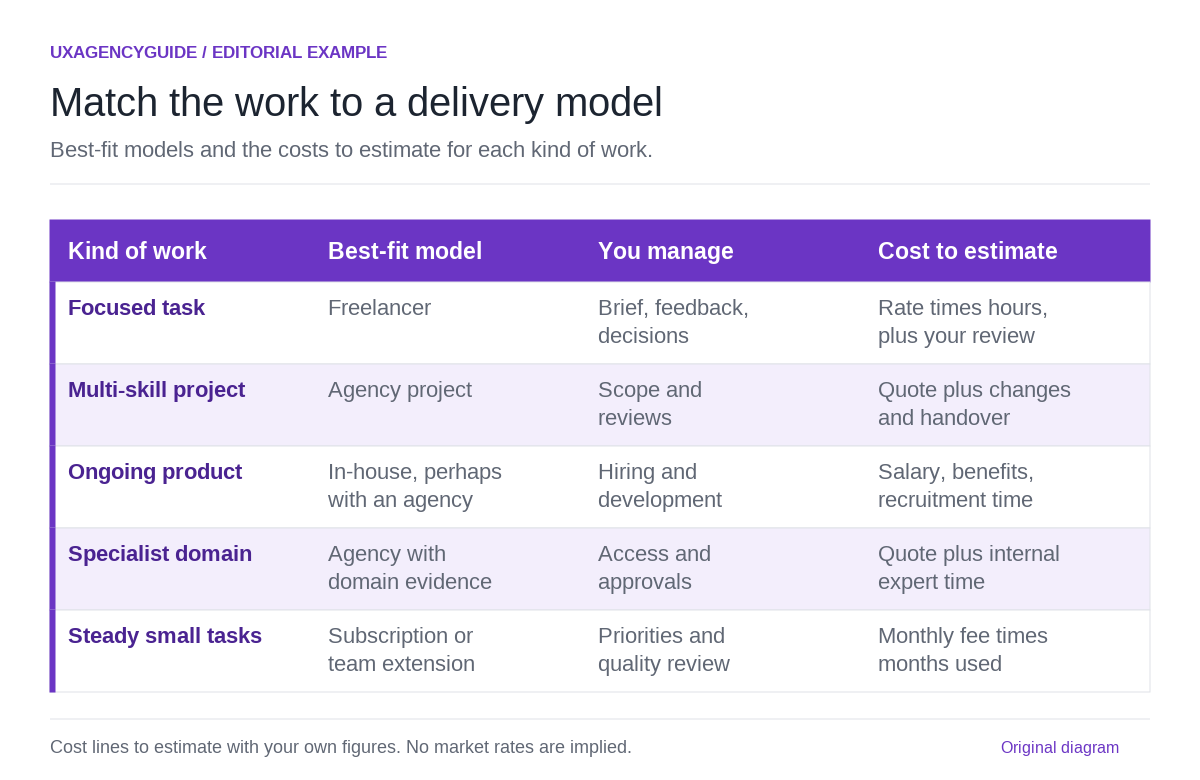
A worked structure
For each option, estimate the total cost over the same period, for example twelve months, using these lines:
Freelancer. Hourly or day rate multiplied by expected hours. Add your own time to direct and review the work. Add the cost of finding a replacement if the freelancer becomes unavailable.
Agency project. The quoted price for the scope. Add the cost of changes outside scope, your team’s time in reviews and the effort to transfer knowledge at the end.
Agency dedicated team. Monthly fee multiplied by months. Add onboarding time in the first month and any minimum commitment, such as six months for several models above.
In-house. Salary plus benefits, taxes, equipment and tools. Add recruitment cost and the months before the hire is fully productive. Add management time and the cost of training.
Example comparison (illustrative)
Suppose a SaaS startup needs continuous product design for a year. Two options look similar on monthly cost. A dedicated agency designer starts in two weeks with no recruitment cost but requires a six-month minimum and leaves with their knowledge at the end. An in-house designer takes three months to recruit and two more to become fully productive, but stays and accumulates knowledge. Over twelve months, the agency delivers more design time; over three years, the in-house designer usually delivers more value per month. Neither is universally cheaper. The right choice depends on how long the need will last.
Management and knowledge transfer
Every model needs management. The question is who does it and how much.
Directing the work
A freelancer needs clear direction from you: briefs, feedback and decisions. An agency manages its own team, but still needs a decision-maker on your side. An in-house team needs a manager who understands design. If nobody in the company can give design direction, a freelancer will struggle and an agency with strong leadership may be the safer choice.
Making knowledge stay
External work is only as valuable as what remains after it ends. Ask any external partner to provide:
- Design files organized so your team can find and edit them.
- Research findings with evidence, not only conclusions.
- A decision log explaining why key choices were made.
- Component and pattern documentation if a design system was built.
- A handover session with the people who will continue the work.
Dedicated-team models make this easier because the external team works in your tools from the start. UX Studio and Cieden both describe designers working inside the client’s processes. CorLab Tech describes a team lead reporting weekly and the client approving every team member, which gives you visibility as the work happens.
Trial periods
A few agencies offer trials, and they differ: UX Studio describes a free five-day trial, Arounda a free three-day trial on its design tiers, and CorLab a first trial month on the client’s real backlog without saying whether that month is free. Ask whether a trial is paid and what commitment follows it. A trial is a useful way to judge working style, but judge it on a real piece of work and agree in advance what success looks like.
Questions to ask each option
Ask the same questions of every freelancer, agency or candidate so the answers can be compared. Our agency evaluation scorecard turns the answers into a structured comparison.
- Who exactly will do the work? Names and roles, not only the agency’s portfolio.
- Show a comparable piece of work and explain one hard decision. What was considered, what was rejected and why.
- How will you work with our team? Tools, meeting rhythm, who gives feedback and how decisions are recorded.
- What happens if someone is unavailable? Holidays, illness or leaving.
- What will we have at the end? Files, research, documentation and a handover.
- How do changes in scope work? For fixed projects especially.
- How do you measure whether the work succeeded? The answer shows whether the partner thinks about outcomes or only deliverables.
Contracts, files and ownership
Agree in writing who owns the design files, research data and any code produced, and when ownership transfers. Make sure files are kept in accounts your company controls, or are transferred at agreed points. Confirm confidentiality terms, especially if research involves customers or sensitive data. Agree notice periods and what happens to work in progress if the engagement ends early. These details are easy to overlook at the start and difficult to fix later, whichever model you choose.
Choose a hybrid when useful
Most growing companies end up combining models. Common hybrids:
In-house lead plus agency. One in-house designer owns the product and design decisions; an agency handles research, a redesign or specialist work. The in-house designer keeps knowledge in the company.
In-house team plus freelancers. An in-house team handles core product work and brings in freelancers for overflow, illustration, motion or specialist tasks.
Agency first, then in-house. A startup uses an agency to design and launch an MVP, then hires an in-house designer as the product grows, with the agency handing over.
Engineering partner plus design specialist. A build partner provides engineering and some design capacity, while a separate design specialist leads research and key decisions.
Rules for any hybrid
- Name one owner of design decisions, usually someone in-house.
- Record knowledge where the in-house team can find it.
- Define who does what in writing, so external and internal work do not overlap or leave gaps.
- Review the arrangement regularly, because the right mix changes as the product grows.
A quick decision guide
| If the work is | Start with |
|---|---|
| A focused, well-defined task | A freelancer |
| A multi-skill project with an end date | An agency project |
| Specialist, regulated or high-risk | An agency with domain evidence |
| Continuous product work, long term | An in-house designer, possibly with agency support |
| A steady flow of small tasks | A design subscription or team extension |
| An MVP you also need built | An agency or build partner with design included, with an in-house owner |
Whichever model you choose, write a short brief, such as our UX design brief template, that describes the work, the skills needed, the expected duration and who owns the result. That brief makes it possible to compare freelancers, agencies and candidates fairly, and to evaluate the arrangement later.
Revisit the decision as you grow
The right model changes with the company. A model that suits a pre-launch startup, such as a short agency project or a freelancer, often stops fitting once the product has paying customers and a steady roadmap. Review the arrangement at natural points: after launch, when a second product team forms, when design requests start queuing for weeks or when external partners repeatedly need to relearn the product. Each of those is a signal that it may be time to bring design ownership in-house, add specialist support or change the mix. Treat the delivery model as a decision you revisit, not one you make once.
Frequently asked questions
Is a UX agency or a freelancer better?
It depends on the work. A freelancer suits a well-defined task that one skilled person can complete, such as a focused audit or a set of screens. An agency suits work that needs several skills, a team that can scale, or continuity if someone leaves. For ongoing product work, an in-house designer or an embedded team is often better than either.
When should a company hire an in-house UX designer?
When design work is continuous, closely tied to the product and expected to last. In-house designers build deep product knowledge and relationships with engineers. For many startups, a first in-house designer becomes worthwhile once there is a steady stream of product work rather than occasional projects.
What is a design subscription?
A design subscription gives you dedicated design capacity for a recurring monthly fee, often with tasks handled within a set number of hours and the option to pause or cancel. One agency in this guide offers part-time and full-time designer tiers with a short free trial. Subscriptions suit a steady flow of smaller tasks better than a large project with a fixed outcome.
How do I compare costs between models?
Compare total cost for the same scope and period, not hourly rates. Include management time, onboarding, recruitment, tools, benefits for employees, and the cost of knowledge lost when an external team leaves. Write down your assumptions so the comparison can be checked.
Can I combine models?
Yes. Many teams combine an in-house designer who owns the product with an agency for research or specialist work, or a freelancer for overflow. The key is to name one owner for design decisions and make sure knowledge is recorded where the in-house team can find it.
Sources & evidence
- What each role does in a service teamChecked 2026-11-20
- Dedicated design teamChecked 2026-11-20
- UX design and development agency for B2B SaaSChecked 2026-11-20
- Design system servicesChecked 2026-11-20
- Product design servicesChecked 2026-11-20
- Product discovery servicesChecked 2026-11-20
- Dedicated development teamsChecked 2026-11-20
- Pricing for product design and developmentChecked 2026-11-20
- AI product design agency for regulated and enterprise AIChecked 2026-11-20
Specific sources, useful examples and clear limitations make advice easier to assess.
Read the editorial policy