UX design for a startup means using research and prototypes to reduce the riskiest uncertainty in your product before you pay to build it. The goal is not a polished interface. It is evidence that the people you are building for can and will complete the core task in the way you expect. Done well, a few weeks of design work decides what goes into the MVP, what stays out and what still needs testing.
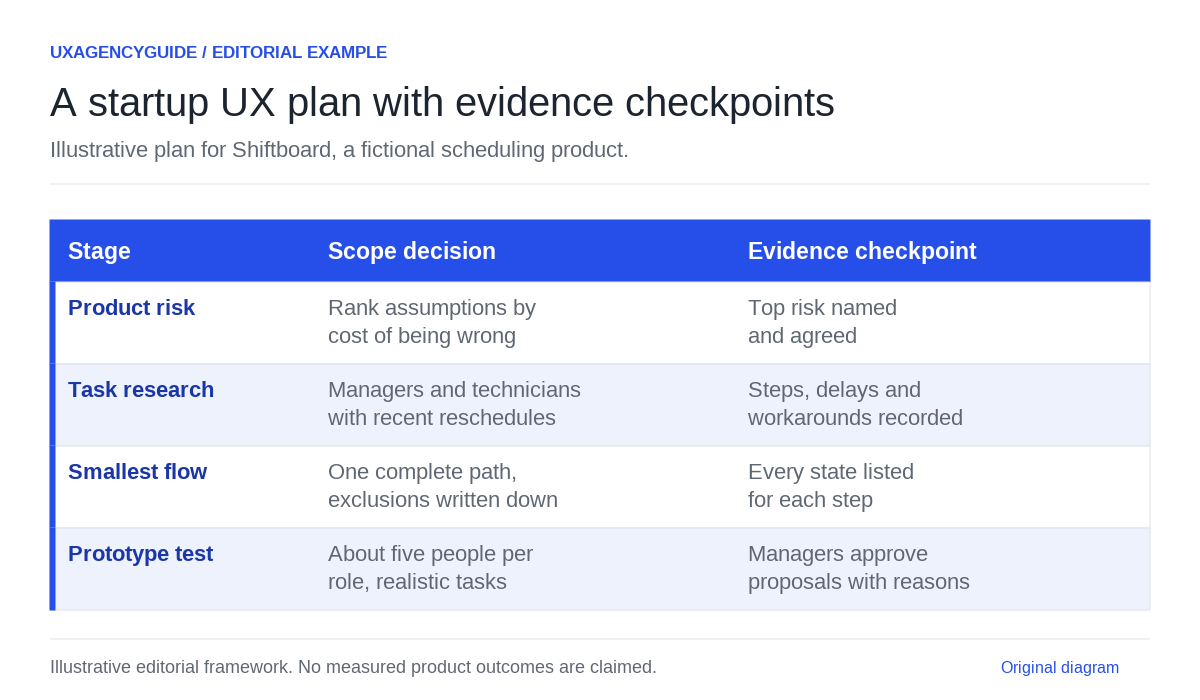
This guide sets out a practical sequence for founders: identify the product risk, research the core task, map the smallest useful flow, prototype and test it, then hand it to engineering in a form developers can build from. We use a fictional product, Shiftboard, a maintenance-scheduling tool for small facilities teams, as a running example. It is illustrative, not a real company, and the figures in it are planning assumptions rather than results.
Start with the product risk
Every early product carries several kinds of risk, and design can only reduce some of them. Name them before deciding what to design.
- Value risk: do people have the problem badly enough to change how they work?
- Usability risk: can they understand and complete the core task with your product?
- Feasibility risk: can the product actually be built with the data, integrations and budget you have?
- Viability risk: will it make money, and can you reach the people who need it?
Design work speaks most directly to value and usability. Feasibility usually needs a technical proof of concept, and viability needs pricing and sales experiments. Our comparison of proof of concept, prototype and MVP explains which artifact tests which risk.
For Shiftboard, the founders believe facilities managers waste hours each week rescheduling technicians when jobs overrun. The riskiest assumption is not whether a scheduling screen can be built. It is whether a manager will trust a tool to suggest a new schedule, and whether technicians will check it. That is a usability and value question, which makes design the right first investment.
Write your riskiest assumptions as statements you could be wrong about, then rank them by how much damage a wrong answer would do. Design the first work around the top one or two.
Research the core user task
Research at this stage has one job: understand how the core task happens today, in enough detail to design a better way. You do not need a large study. You need to talk to the right people about real recent events.
GOV.UK’s guidance on how the discovery phase works is a useful model even outside government. It treats discovery as a period for learning about users, constraints and the real problem before building, says teams should not start building in discovery, and suggests around four to eight weeks is typical. A startup can move faster, but the principle holds: understand the problem before committing to a solution.
Who to talk to
Recruit people who do the task now, not people who might like the idea. For Shiftboard that means facilities managers who scheduled technicians last week, and technicians who received schedule changes. Five to eight conversations per group often show the main patterns, though you should keep going if each interview still surprises you.
What to ask
Ask about specific recent events rather than opinions. “Tell me about the last time a job ran over and you had to change the schedule” produces far better evidence than “Would you use a tool that reschedules automatically?” Listen for workarounds, such as spreadsheets, group messages and phone calls, because they show where the current process fails and what people already value.
What to record
Capture the steps, the people involved, the information each person needs, and the moments of delay or error. For Shiftboard, research might show that managers do not distrust automation in general; they distrust it when they cannot see why a technician was moved. That finding changes the design priority from speed to explanation.
Map the smallest useful flow
With the core task understood, map the smallest flow that delivers the value you are testing. This is where many startups overbuild. An MVP needs one complete path through the core task, not every feature on the roadmap.
Start from the outcome and work backwards. For Shiftboard, the outcome is a technician arriving at the right job after a schedule change. The smallest useful flow might be: the manager sees that a job is overrunning, the product proposes a revised schedule with reasons, the manager approves or adjusts it, and affected technicians are notified and confirm.
Then list what that flow does not include for now: multi-site scheduling, payroll, reporting, integrations with every calendar. Writing exclusions down protects the scope when stakeholders inevitably ask for more.
Account for every state
A flow is more than the successful path. For each step, note the states a real user will meet: no jobs yet, data still loading, a technician who has not responded, a proposal the manager rejects, a notification that fails. These states are where early products often break, and designing them before the build is much cheaper than discovering them afterwards.
Choose the fidelity
Sketches and wireframes are enough to agree the structure of the flow with your team. Our wireframe, mockup and prototype comparison explains when each is useful. Move to a clickable prototype only when you are ready to test the flow with users.
Prototype and test assumptions
A prototype for a startup is a question you can put in front of users. Build only as much as the question needs. GOV.UK’s guidance on making prototypes notes that more realistic prototypes produce better research evidence; the trade-off is time. A clickable design prototype is often enough to test whether people understand a flow. A coded prototype with real data is better when the realism of the content matters, for example to see whether managers trust a proposed schedule.
Write realistic tasks
Give participants a goal, not instructions. Nielsen Norman Group’s guidance on task scenarios recommends tasks that are realistic and actionable and that avoid hinting where to click. For Shiftboard, “A job at the north site is running two hours late. Make sure the afternoon is covered” is a good task. “Click the reschedule button” is not.
Test small and often
Nielsen Norman Group’s well-known guidance on testing with five users argues that small qualitative rounds reveal most major problems, and that several small rounds beat one large study. For a startup, that means testing with around five people, fixing what you learn and testing again. If you have distinct groups, as Shiftboard does with managers and technicians, include a few people from each.
Separate what you observed from what you concluded
Record what participants did, where they hesitated and what they said, separately from your interpretation. If three of five managers overrode the proposed schedule, note that as an observation. Whether it means they distrust the suggestion, misunderstood it or simply prefer control is an interpretation that needs further evidence.
Know when to stop
Set a checkpoint before you start: what result would make you change the design, and what result would make you change the product direction? For Shiftboard, if managers consistently approve proposals once they can see the reasons, the design direction is supported. If they ignore proposals entirely, the value assumption is in question, and more interface polish will not fix it.
Prepare design and engineering handoff
Handoff is where startup design work most often loses value. A set of attractive screens without states, rules and scope leaves developers guessing, and the guesses become the product.
A useful MVP handoff includes:
- The flow map with every step and state, including empty, loading, error and permission states.
- Screens for each state, with real or realistic content rather than placeholder text.
- Rules and logic, such as who can approve a schedule and what happens when a technician does not confirm.
- Scope notes that say clearly what is in the MVP and what is deliberately excluded.
- Open questions and assumptions, so engineers know which decisions are provisional.
- Research evidence linked to the key decisions, so the reasoning survives when people join the team.
If you are commissioning this work, our UX design brief template includes a filled example for the same fictional product. Walk developers through the flow in person or on a call. The questions they ask in that session usually reveal the gaps that would otherwise surface as bugs.
How agencies structure this stage
Agency approaches to startup design vary in how much they cover, and the differences are useful when deciding what you need. Metalab’s archived Slack case is a historical example of design work beginning from an early, unstyled prototype the client already had, and covering product, brand, mobile app and marketing site. It shows design arriving after the founders had already tested a rough version.
Arounda’s MVP service page describes a design-led process of discovery, information architecture covering the path from registration to a key action, prototyping, user testing and launch support, with deliverables from three months. Its Sinta case describes combining separate flows for managers, HR specialists and technical interviewers into one, which is a good example of reducing MVP scope through design rather than features.
CorLab Tech’s MVP development page describes an engineering-led sequence: a one-week scoping sprint that ends in a build plan and fixed price, a clickable flow in the second week, then build with weekly demos and launch around week seven. It publishes a starting price of $10,000 and says the client owns the code. In this model, design is compressed into a short phase, so the research and core-flow work described above needs to happen before you engage the builder or in parallel with them.
None of these is the right model for every startup. If your riskiest question is usability or value, prioritize research and prototyping. If it is feasibility or speed to market, an engineering-led partner may suit you, provided you bring clear evidence about the core task. Our startup agency guide covers how to choose.
Plan the next iteration
An MVP launch is the start of a new round of learning, not the end of design. Plan what you will learn from the first release before it ships.
Decide what to measure
Choose a small number of signals tied to the core task. For Shiftboard, useful signals include how often managers accept proposed schedules, how often they edit them, and how quickly technicians confirm changes. Avoid vanity measures such as sign-ups alone, which say little about whether the product is useful.
Keep talking to users
Analytics show what people do; conversations explain why. Schedule a few interviews with early users in the first weeks after launch, and watch at least some of them use the product on their own work. The patterns you see will usually differ from what the prototype tests predicted, because real data and real pressure change behavior.
Revisit the risk list
Return to your ranked assumptions. Some will now be supported, some disproved and some still open. The next round of design work should address the riskiest open assumption, which may now be about a different user group, a second workflow or pricing rather than the original core task.
Keep a decision log
Record each significant product decision with the evidence behind it and the date. In a startup, people and priorities change quickly. A short log saves the team from repeating research or reopening settled questions, and it helps new designers and engineers understand why the product works the way it does.
Common startup UX mistakes
Most early UX problems come from a small set of habits. Recognizing them early saves weeks.
Designing the whole product before testing the core task. Teams often design onboarding, settings, billing and reporting before anyone has tested whether the central workflow works. Design the core task first, test it, and let the results decide what else needs designing.
Testing with friends, investors or colleagues. People who know the founders, or who are not in the target audience, are polite and lack the context of real users. Their feedback feels encouraging and is rarely predictive. Recruit people who do the task today, even if it takes longer.
Asking people whether they would use the product. Hypothetical questions produce hypothetical answers. Ask about what people did recently, and watch what they do with a prototype. Behavior is far better evidence than stated intent.
Treating the prototype as the specification. A prototype built to test one question often skips states, rules and edge cases. If engineers build directly from it, those gaps become product defects. Prepare a proper handoff even when the prototype looks complete.
Polishing visuals before the flow is settled. High-fidelity screens make a design feel finished and make teams reluctant to change it. Keep fidelity low until the structure and flow have survived testing, then invest in visual design.
Ignoring the second user group. Many products depend on someone other than the buyer. In Shiftboard, the dispatcher buys the value but the technician must confirm changes for it to work. If the second group is not researched and tested, the product can fail even when the first group loves it.
Skipping accessibility until later. Retrofitting accessibility into a released product is expensive. Building it into components and flows from the start costs little and widens the audience from day one.
Avoiding these mistakes does not require a large team. It requires deciding what you need to learn, choosing the cheapest way to learn it and acting on what you find.
A realistic timeline
For a single core task, a lean version of this process can fit into four to eight weeks: one or two weeks of research, a week of flow mapping, two or three weeks of prototyping and testing in small rounds, and a week preparing handoff. Complex domains, several user groups or regulated data extend that. The timeline matters less than the checkpoints. Each stage should end with a clear decision based on evidence, including the option to change direction before the expensive part begins.
Frequently asked questions
When should a startup invest in UX design?
Before the main build, while changes are still cheap. A few weeks of research and prototyping on the core task usually costs far less than rebuilding a released product. The amount of design should match the risk: a familiar task needs less exploration than a new workflow or an unfamiliar audience.
How many users should a startup test with?
For a qualitative usability test of one user group, around five participants usually reveals the main problems, and several small rounds are more useful than one large one. If your product serves clearly different groups, such as buyers and administrators, test a few people from each group.
Can founders do UX research themselves?
Yes, especially early on. Founders can run interviews and simple usability tests if they prepare realistic tasks, avoid leading questions and record what people do rather than only what they say. Bring in specialists when the domain is complex, the stakes are high or the team keeps hearing what it hopes to hear.
What should a designer hand to developers for an MVP?
A prioritized list of flows, the screens for each with their empty, loading, error and permission states, the content and rules behind them, and a clear note of what is out of scope. Open questions and assumptions should be written down so engineers know which decisions are still provisional.
Sources & evidence
- How the discovery phase worksChecked 2026-11-20
- Making prototypesChecked 2026-11-20
- Why you only need to test with 5 usersChecked 2026-11-20
- Turn user goals into task scenarios for usability testingChecked 2026-11-20
- Slack product design case studyChecked 2026-11-20
- Hire MVP designersChecked 2026-11-20
- MVP design for an HR recruitment platformChecked 2026-11-20
- MVP development for startupsChecked 2026-11-20
Specific sources, useful examples and clear limitations make advice easier to assess.
Read the editorial policy