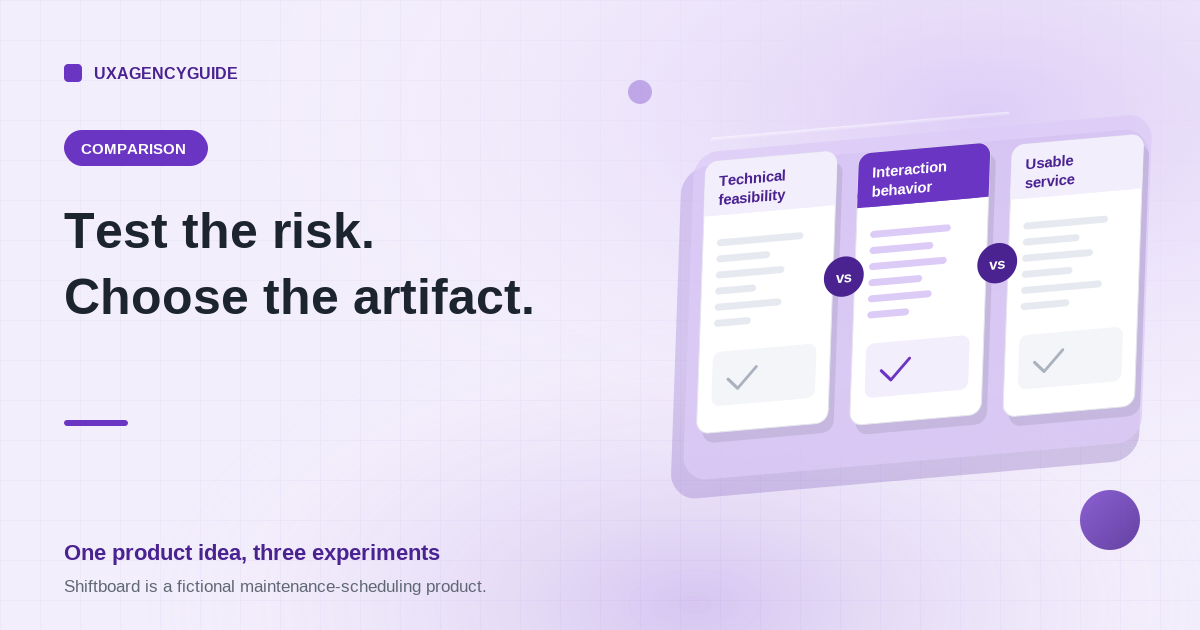
A proof of concept asks whether a difficult part can work. A prototype asks whether a proposed experience makes sense. An MVP puts a deliberately small offer into real use so a team can learn whether it creates enough value to continue. Choose the next artifact by the uncertainty that could change your decision, rather than by a fixed sequence of deliverables.
That distinction matters when a founder commissions design or development. A convincing demonstration can still avoid the hardest integration. A technically successful experiment can still be unusable. A small working product can still fail to address an important problem. Calling all three an MVP makes it harder to know what the project has actually established.
The short decision answer
Start by completing this sentence: “We should not spend more on this idea until we know whether…” The rest of that sentence defines the work. If the uncertainty concerns access to a data source, investigate feasibility. If it concerns how people understand a workflow, prototype the interaction. If it concerns continued use, payment or operational delivery, design a small real-world release with appropriate safeguards.
These choices can overlap. A prototype may contain working code. A minimum viable offer may initially rely on manual operations. An integration experiment may need a basic interface so an engineer can inspect results. The label describes the learning objective, not a file type or the number of screens.
Our comparison uses an illustrative product called Shiftboard, a maintenance scheduling service for a small property team. This is a fictional example, not a client case study or a tested business. Its purpose is to show how one idea generates three different assignments. No success rates, conversion improvements or project fees are implied by the example.
The main buying question is therefore practical: what evidence will this engagement produce, and what decision will that evidence support? Ask the supplier to answer that question before agreeing to a broad scope. A well-defined experiment can be small without being superficial.
What each artifact tests
Proof of concept: technical feasibility
Shiftboard needs to read work orders from an existing property-management system. The founder does not know whether the available interface exposes enough information or whether access restrictions make the workflow impractical. A proof of concept could connect to a permitted test environment, retrieve representative records and demonstrate how updates would be handled.
The output might be a script, a technical note and sample responses. It needs assumptions, dependencies, observed limitations and a recommendation. It does not need an elegant dashboard unless the interface itself is part of the feasibility question. A successful connection with a single clean record would not establish reliable handling of every real-world exception.
Define the exit condition carefully. “The integration works” is too vague. “The permitted API can retrieve the fields needed for the scheduling task, and the team has documented the missing fields and update constraints” is a useful result. A negative result can save money if it changes the product direction before a larger build.
Prototype: experience and interaction
The next uncertainty might be whether a coordinator can assign a technician without losing track of urgent work. A prototype can show the work-order list, task details, assignment control and confirmation. It can also represent permission limits, conflicting assignments and cancellation.
The prototype does not need a live scheduling engine to support a discussion about hierarchy or wording. It does need enough behavior to expose the question under examination. If a study asks whether people notice a scheduling conflict, the conflict state must exist. A clickable happy path cannot answer that question by itself.
The GOV.UK guidance on making prototypes describes using prototypes to explore and test designs before committing to a service build. That guidance comes from government service delivery. Here we apply the same broad distinction between exploring an interaction and operating a production service, rather than assuming identical procurement or delivery requirements.
MVP: a small real offer
An MVP for Shiftboard could let one permitted customer team receive work orders, assign a technician and track completion. The scope would exclude unrelated property accounting, a marketplace and sophisticated route optimization. The release still needs sufficient security, permission handling, operational support and data protection for its actual use.
Small does not mean careless. A maintenance task may reveal addresses, names or access instructions. Even a limited pilot must decide who can see that information and how mistakes are corrected. The learning objective does not remove responsibility for the people using the service.
An MVP can include manual work if that is explicit. A coordinator might reconcile an exception outside the interface during the pilot. Record that operational dependency. Otherwise, the team may mistake founder effort for a repeatable product capability and underestimate what a broader release requires.
Comparison table
| Decision | Proof of concept | Prototype | MVP |
|---|---|---|---|
| Primary question | Can a critical mechanism work? | Can people understand and use the proposed flow? | Does a small real offer create useful value? |
| Typical evidence | Observed technical result and documented constraints | Observations from reviewing or testing represented behavior | Real use, operational learning and relevant business evidence |
| Production use | Usually unsuitable without further work | Usually simulated or deliberately incomplete | Intended for bounded real use |
| What can remain simplified | Presentation and unrelated functionality | Infrastructure and unrepresented features | Features outside the agreed core task |
| Important boundary | Feasibility is not usability | Usability is not market demand | Early use is not proof of sustainable scale |
| Useful handoff | Technical findings and dependencies | Source files, states and research notes | Operating product, support plan and next learning questions |
Read this table as a set of commissioning questions, not a rule that every project needs three separately purchased phases. An existing team may already know that the integration is feasible. Repeating a proof of concept would add little unless a new dependency or constraint changes that knowledge.
Likewise, a paper prototype can be enough to challenge an assumption about terminology. Buying an elaborate coded demonstration would not automatically improve that conversation. Choose fidelity and scope in proportion to the evidence required.
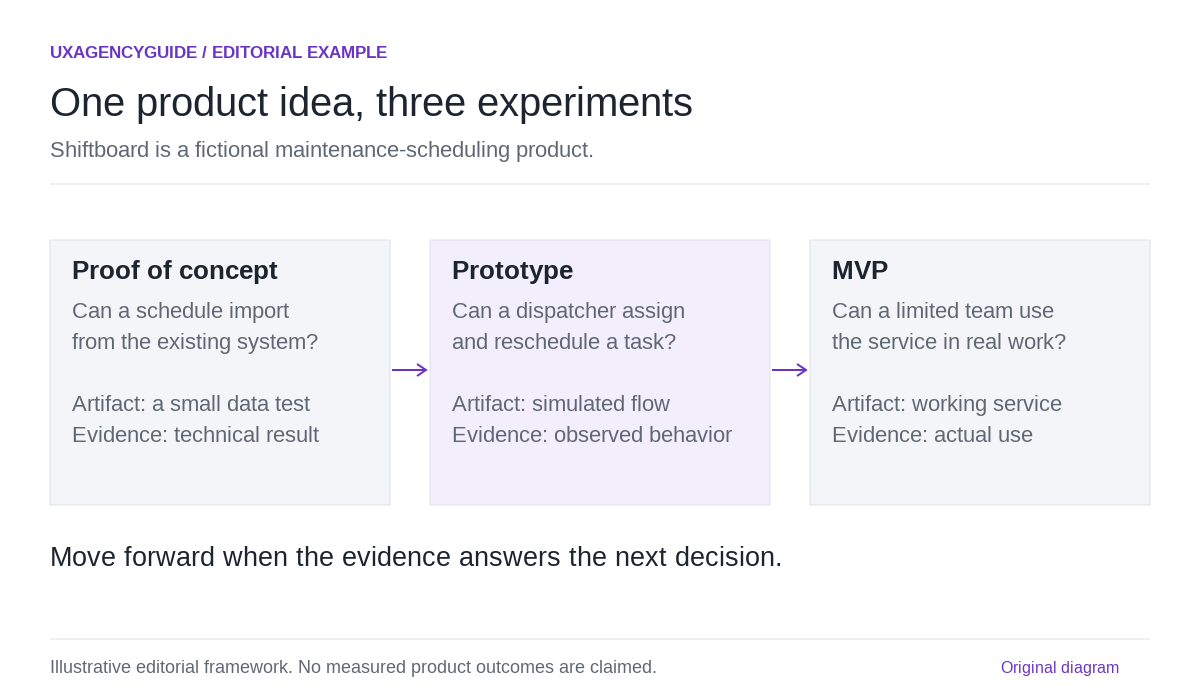
One idea at three stages
Stage one: write the uncertainty register
Before drawing screens, the Shiftboard team lists its important unknowns: access to work-order data, the coordinator’s assignment decision, a technician’s ability to update a task and whether the workflow is useful enough to replace the current workaround. Each unknown receives an owner and a proposed source of evidence.
The register prevents one result from being stretched too far. A technically valid update does not mean the technician understood the status label. A positive interview does not mean a company will pay. A coordinator completing a prototype task does not establish that a real integration will remain reliable.
For every unknown, include what would change the plan. If missing data would make the service unusable, feasibility has priority. If the data is already available but the assignment process is unclear, interaction work may be the better next investment. Make that ordering visible to the designer and engineer together.
Stage two: prepare a realistic assignment flow
The prototype uses an example work order with an urgent but non-emergency maintenance issue. The coordinator must choose a technician, see a relevant availability constraint and confirm the assignment. The source files contain the initial state, a conflict state, a successful assignment and a route back to the task list.
The research task should describe the situation rather than dictate the clicks. “Arrange a technician for this issue without replacing an existing appointment” leaves room to observe behavior. “Click Assign, choose Tuesday and press Confirm” mainly tests whether the person can follow an instruction.
If the prototype uses simulated availability, state that in the research record. A participant’s successful path remains evidence about that represented interaction. It is not an observed result for real calendar synchronization. Keep the demonstration useful by preserving its limits.
Stage three: define the smallest service boundary
For a working release, Shiftboard chooses one customer context and one kind of work order. It documents permission roles, support responsibilities, data deletion and how to reverse an incorrect assignment. The release criteria include those operational details alongside the visible interface.
The team then chooses learning measures that match the question. Task completion can help identify workflow friction. Repeat use may indicate practical usefulness. Payment or renewal evidence addresses a different question. None should be interpreted without its sample, timeframe and operating conditions.
Record unexpected manual assistance. If the founder explains every task, the team has learned something about supported onboarding rather than self-service usability. If an engineer repairs records during the pilot, note the intervention rather than presenting the experience as fully automated.
Cost and evidence boundaries
There is no defensible universal price for a proof of concept, prototype or MVP. A prototype involving a single administrative flow is a different assignment from a regulated clinical workflow with several roles. An integration against a documented sandbox differs from one requiring permission negotiations and uncertain legacy data.
Compare proposals through their inclusions. Ask how many flows and states are covered, whether research recruitment is included, who writes realistic content and what source files are delivered. For a working release, ask about deployment, security responsibilities, support, monitoring and the treatment of out-of-scope features.
Separate fixed learning work from production hardening. A throwaway feasibility script may have no automated tests or support commitments. If the supplier expects it to become part of the released system, the proposal should explain the extra work required. Reusing code is an engineering decision, not a saving that can be assumed from the artifact’s name.
The same caution applies to visual fidelity. A polished demo can create pressure to ship because it looks finished. That impression says little about permissions, failure handling or maintainability. Keep an explicit record of what is simulated and what remains unimplemented.
How suppliers package each stage
Agency service pages show how differently the same labels are sold. Cieden’s AI prototyping service separates a feature exploration sprint, a proof-of-concept app and an MVP app. It lists published starting prices of $8,000, $16,000 and $32,000, with indicative timelines of two, four and eight or more weeks. The agency describes its proof-of-concept tier as a working application with real AI integrations rather than static mockups, which places it closer to a feasibility test than to a clickable prototype.
CorLab Tech’s MVP development page describes an engineering-led sequence: a one-week scoping sprint that ends with a build plan and a fixed price, a clickable flow of the product in week two, a build phase with weekly demos, then launch and two-week iteration cycles. It states a starting price of $10,000 and says the client owns the code from the first commit. That is an MVP offer in the sense used here, a small working release, with design compressed into a single week.
Metalab’s archived Slack case is a historical example from the other direction. The agency describes starting from an early, unstyled prototype that already existed and turning it into a designed product, brand, mobile app and marketing site. A prototype can come from the founding team rather than the design partner, and the commission then begins at a later stage.
Work & Co’s process page describes development starting at kickoff and a full design cycle with an early prototype in about 20 days, so prototype and build overlap rather than follow each other. Its client pages show what that is for: deciding the shape of the first release with evidence. For Roo, built for Planned Parenthood, Work & Co describes months of research and concept testing with teenagers, who did not want to download another app, so the first release was a mobile website, and who wanted to ask questions privately, so it was fully anonymous. For Hippo, the agency says it chose to focus on the enrollment experience first. In both cases the prototype stage settled what the MVP would be, which is exactly the decision this comparison is about.
These prices were checked on 20 November 2026 and are published starting points, not quotes. Compare what each tier includes, especially research, user testing and code ownership, rather than the label alone.
Assign responsibilities across suppliers
Where different providers handle research, design and engineering, define who resolves contradictions. A designer may assume that a scheduling constraint is available through the API while an engineer discovers that it is not. Without an owner for that decision, the project can produce attractive screens and disconnected technical notes.
Request a shared handoff containing the question, evidence, unresolved assumptions and recommended next action. An agency’s stated service category is only a starting point. Ask for a relevant example showing its actual responsibility, rather than inferring that a development provider has validated the user experience or that a design provider will operate the released software.
Use the startup agency guide to evaluate partner fit, and the wireframe, mockup and prototype comparison to specify design deliverables. Those decisions support this process without requiring a separate contract for every label.
Choose the next experiment
Write a one-page experiment brief before selecting a tool. Include the assumption, the intended participants or system conditions, the artifact, the observations to record and the decision that follows. State an exit condition that includes the possibility of stopping or changing direction.
For Shiftboard, a feasibility brief might end with a decision on whether the available integration supports the core scheduling workflow. A prototype brief might end with revisions to the assignment flow and a list of unresolved questions. A pilot brief might end with a decision on whether the service deserves a wider, more robust release.
Do not define success as producing the artifact. A delivered prototype is a project output; a clearer decision is its purpose. If the team cannot explain what it learned, adding fidelity or more features may simply hide an unresolved question behind additional work.
A practical acceptance checklist
- The brief names one primary uncertainty and the decision it affects.
- The artifact represents the states needed to investigate that uncertainty.
- Findings distinguish observed behavior from interpretation and supplier claims.
- Simulated data, manual operations and technical shortcuts are documented.
- Source files, evidence notes and unresolved dependencies have an owner.
- The next step follows from the evidence, including a reason to pause if necessary.
Before commissioning the next phase, ask each stakeholder to explain the current conclusion in plain language. If the founder says the market is validated, the researcher says only the wording was tested and the engineer says the integration is still uncertain, the team does not share the same decision. Resolve that difference in writing. A short evidence review is usually more useful at that point than another round of polished screens.
The most useful sequence is the one that retires consequential uncertainty before it becomes expensive. Sometimes that begins with a technical experiment. Sometimes it begins with a rough interaction or a manually delivered offer. The choice should be explainable in the context of the product, the users and the decision you need to make.
Preserve a stopping decision
Include a short review after the experiment. Record whether the original assumption was supported, contradicted or still unresolved. An inconclusive result can be legitimate if the test environment could not represent an essential condition. It should lead to a deliberate next investigation, not an automatic claim of validation.
For Shiftboard, inaccessible source data might justify changing the integration approach before further interface work. Confusing role language might justify another prototype iteration. A pilot requiring extensive founder intervention might justify improving operations before adding customers. Those are different outcomes, but each can be useful learning when it changes what the team does next.
Frequently asked questions
Can a prototype also be a proof of concept?
Yes, an artifact can serve overlapping purposes if the questions are explicit. A coded interaction might investigate feasibility and comprehension, but each conclusion still needs evidence appropriate to its question.
Does an MVP have to be fully automated?
A bounded offer may include manual operations when those dependencies are explicit and appropriate safeguards exist. Record the manual effort so it is not mistaken for a repeatable product capability.
Which should a founder build first?
Start with the uncertainty that could most affect the decision to continue. Technical feasibility, interaction comprehension and real-world value may require different experiments.
Sources & evidence
- GOV.UK guidance on making prototypesChecked 2026-11-19
- AI prototyping serviceChecked 2026-11-20
- MVP development for startupsChecked 2026-11-20
- Slack product design case studyChecked 2026-11-20
- Work & Co: Roo for Planned ParenthoodChecked 2026-11-23
- Work & Co: HippoChecked 2026-11-23
Specific sources, useful examples and clear limitations make advice easier to assess.
Read the editorial policy